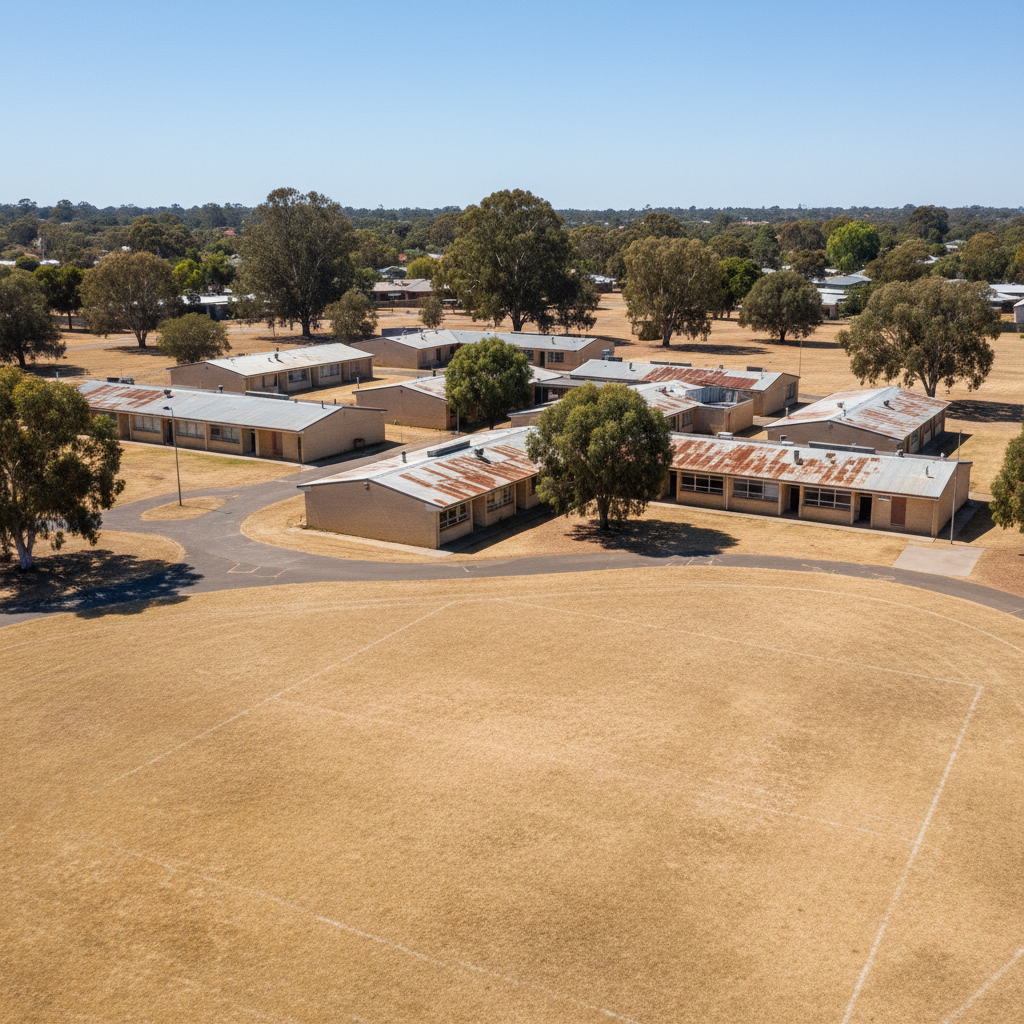
A typical WA school campus. Rusted roofing, dry ovals, cream brick blocks built in the 1970s. 10,400 maintenance defects were documented across 834 schools in February 2024.
The gap
When a teacher at a Western Australian public school notices a broken window, a leaking ceiling, or a failed air conditioning unit, they report it. They call a number or speak to their Facilities Services Manager. The request enters a system they cannot see, managed by a contractor they did not choose, overseen by a department that is not their own.
From that moment, the teacher has no visibility. They do not know if the request was received, actioned, or completed. The first indication that something happened is when a tradesperson appears at the door. Or doesn't.
There is no school-level portal showing the status of open requests. There is no sign-off process where school staff confirm that work was actually completed. There is no photo evidence requirement. There are no records that the school controls.
The school's own maintenance history exists entirely inside someone else's system.
The head contractor for this arrangement - covering 550 schools in the Perth metropolitan area and Peel region - is Programmed Facility Management, a subsidiary of Tokyo-headquartered Persol Holdings. They have held the contract continuously since 1998.
What the Auditor General found
In August 2021, the WA Office of the Auditor General published Report 4: 2021-22 on Public Building Maintenance. The audit covered the Maintenance Services Arrangement that manages approximately 240,000 maintenance jobs per year across public buildings, including the 550 schools.
The findings were direct.
OAG Key Findings - Public Building Maintenance
| Independent verification of contractor invoices | Not done |
| Physical inspection of completed school work | Not performed |
| Large clients raising value-for-money concerns | 3 (incl. Education) |
| Potential duplicate work orders flagged | 6,436 |
| Invoices just below approval thresholds | 1,507 |
| Contractors with sequential invoicing patterns | 862 |
The department responsible for the contract does not verify the transaction data submitted by the head contractor. The data used to calculate the contractor's fees comes from the contractor. Three large government clients, including the Department of Education, raised value-for-money concerns directly to the Auditor General.
The OAG's forensic data analytics flagged 6,436 potential duplicate work orders and 1,507 invoices that fell just below approval thresholds - a pattern consistent with structuring to avoid scrutiny.
The OAG issued five recommendations. All were accepted.
10,400 defects
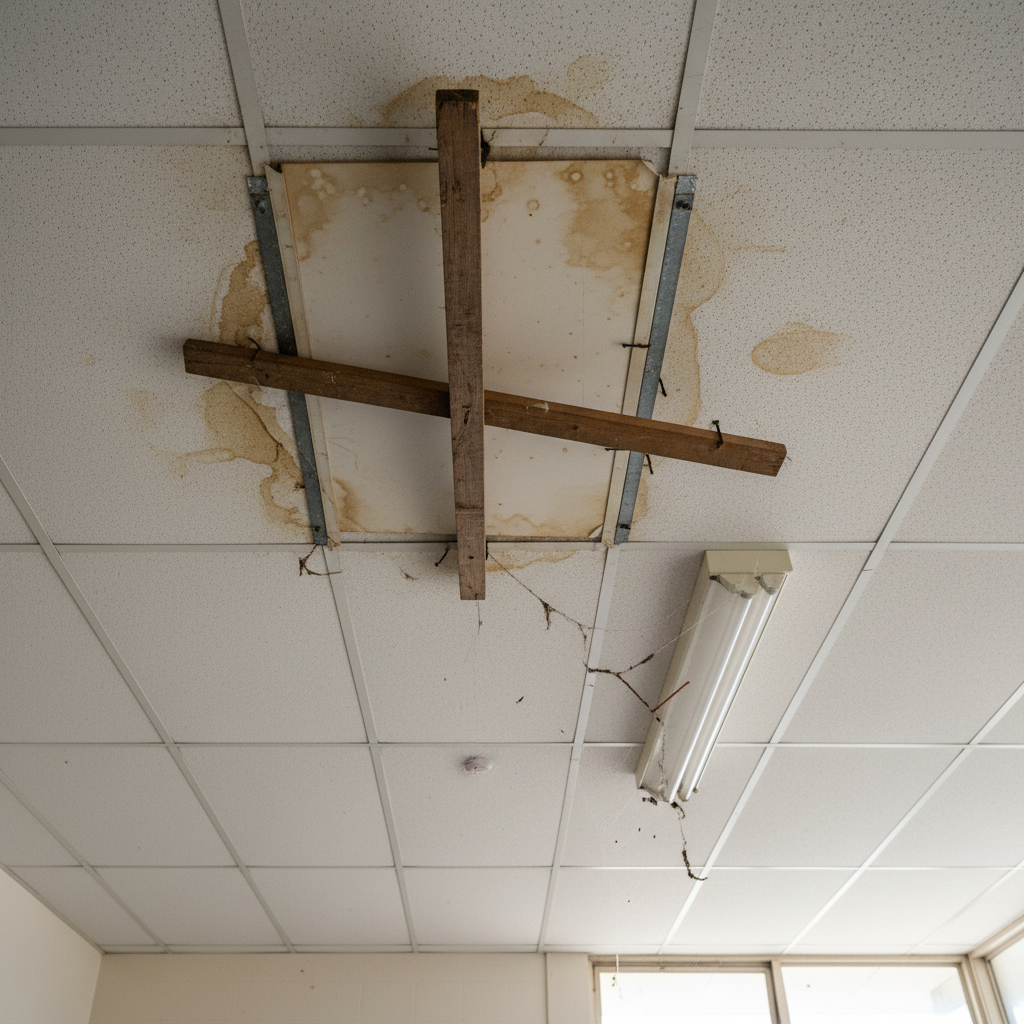
Sagging ceilings held up by wooden battens above student desks. This matches defects documented in the February 2024 Building Condition Assessment.
A February 2024 Building Condition Assessment documented 10,400+ maintenance defects across 834 WA public schools. The defects include cracked walls, sagging ceilings held up by wooden battens above student desks, broken floorboards, mould-riddled transportable classrooms, and windows that have rusted shut.
Schools with most defects - Feb 2024 BCA
| Esperance Senior High School | 121 |
| Manjimup Senior High School | 87 |
| Kent Street Senior High School | 86 |
| Shenton College | 85 |
| Singleton Primary School | 79 |
These figures were cited by Shadow Education Minister Liam Staltari in October 2025 and have not been disputed by the government. The Cook Government announced $1.6 billion over four years for school infrastructure in April 2024, of which $41.8 million was specifically allocated for maintenance upgrades.
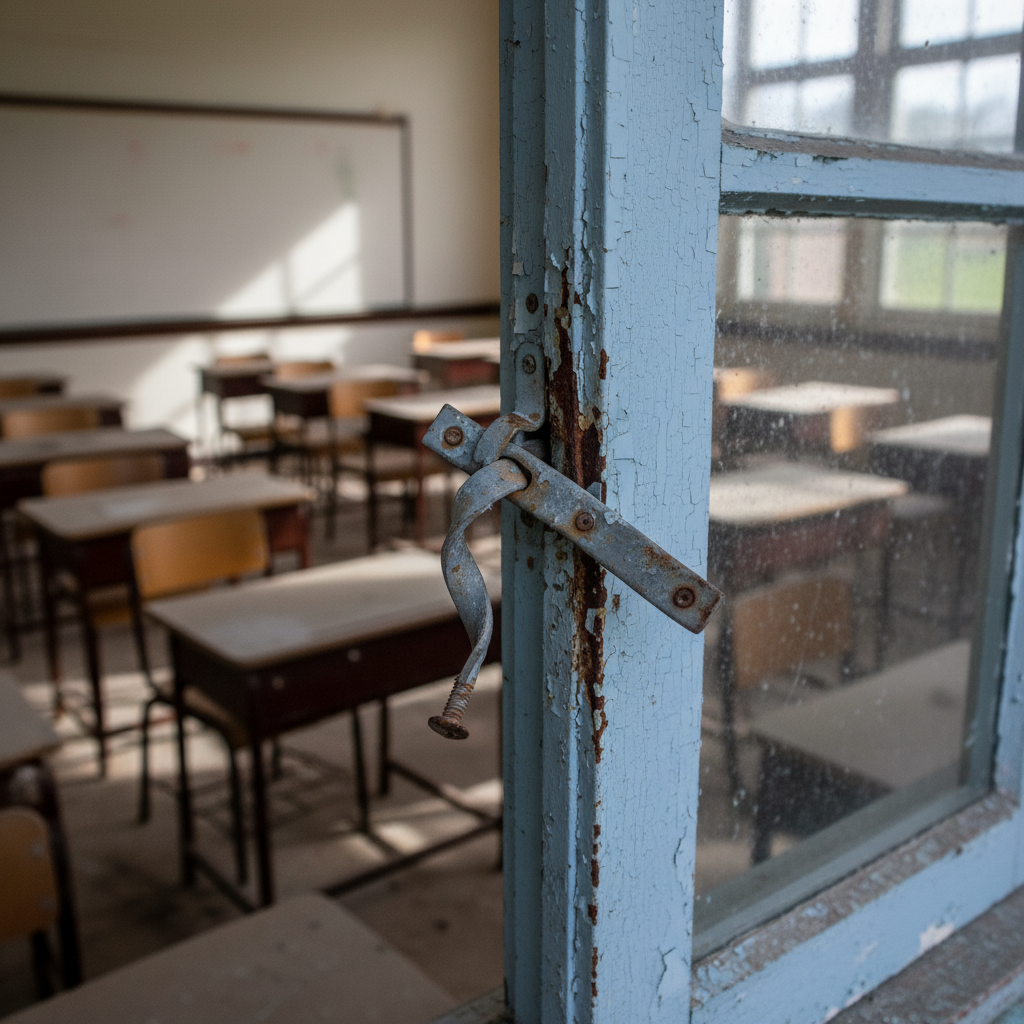
A broken window latch with rusted metal and peeling paint. Through the glass: empty student desks.
What doesn't exist
Based on all available public records, the following mechanisms either do not exist or are not publicly documented in the WA school maintenance system:
Transparency mechanisms - current status
| School staff sign-off on completed work | No evidence |
| Photo evidence of completed work | Not required |
| Planned maintenance schedule visible to schools | No evidence |
| Independent audit trail of contractor visits | Not present |
| Government visibility over subcontractors | Not available |
Schools report a problem and wait. They have no mechanism to track what happens next, verify that work was done, or dispute a contractor's account of what occurred. Their own maintenance history is held in a system they cannot access.
The $60 fix
This tool costs less to run per month than a single emergency callout.
School Maintenance WA is a free, open-source logging application that any school can use right now. It runs in a browser. It stores data locally. It creates an independent, school-controlled record of every maintenance request.
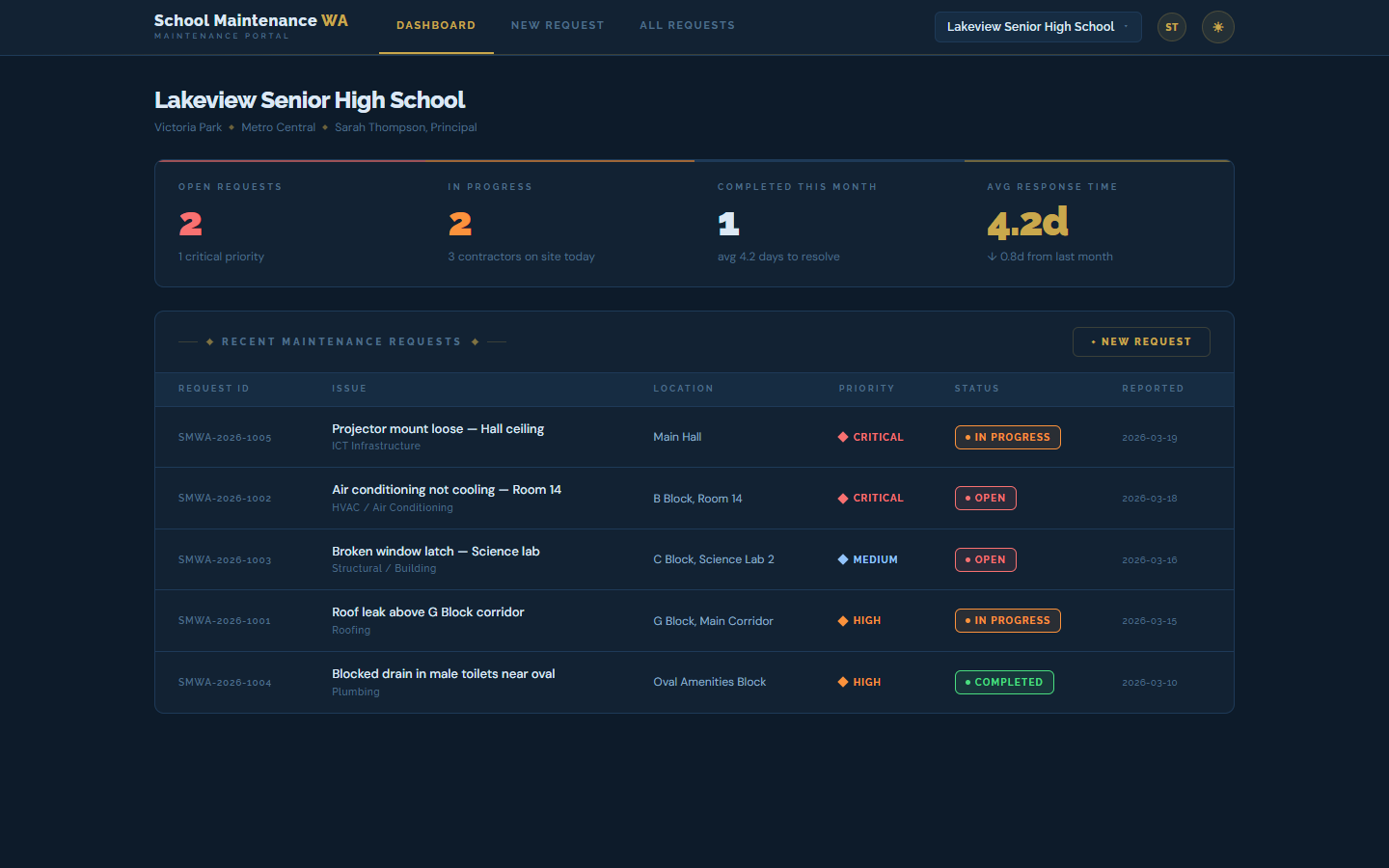
The School Maintenance WA dashboard. Request tracking, status visibility, priority flags.
What it does:
- Log maintenance requests with photos, location, and category
- Track request status from submission through to completion
- Create a timestamped, school-controlled record that nobody else can alter
- Give business managers and principals a dashboard view of their school's backlog
- Provide a record that can be compared against contractor invoices
What it does not do:
- Replace any existing workflow. Schools continue to report maintenance through normal channels.
- Require any cooperation from the contractor or the department.
- Send data anywhere. The school keeps its own records.
This is not a replacement for the current system. It is a parallel record. The school is simply keeping its own notes.
Try the app
| Live demo | schoolfix.vercel.app |
| Access code | schoolfix2026 |
| Source code | GitHub |
| Cost to run | $0 (Vercel free tier) |
What this means
A teacher who logs a broken window in this app has created a timestamped, photo-backed record that the school controls. If the work order shows a different date, a different category, or a different scope of work, the discrepancy is visible. If no work order appears at all, the gap is detectable.
This is not a sophisticated system. It is a spreadsheet with a timestamp and a camera. The fact that it doesn't already exist is the story.
The WA government spends $124 million per year on school maintenance through a contract that has been held continuously by the same Japanese-owned provider since 1998. The Auditor General found that nobody independently verifies the invoices. An app that costs nothing to run could create the independent record needed to start.
If you work at a WA public school, try the tool. Log your next maintenance request in the app and through the normal channels. See what happens to each.